AI Presence report

Does AI actually name your business?

The AI Presence report answers that question from live AI answers, not from your pages. It reports your AI Mention Rate across ChatGPT, Perplexity, Gemini, Claude, and Google AI Mode, then diagnoses the first gate you fall out at and gives you the fix list in order. It is free for now, produced by hand, and takes a few days.

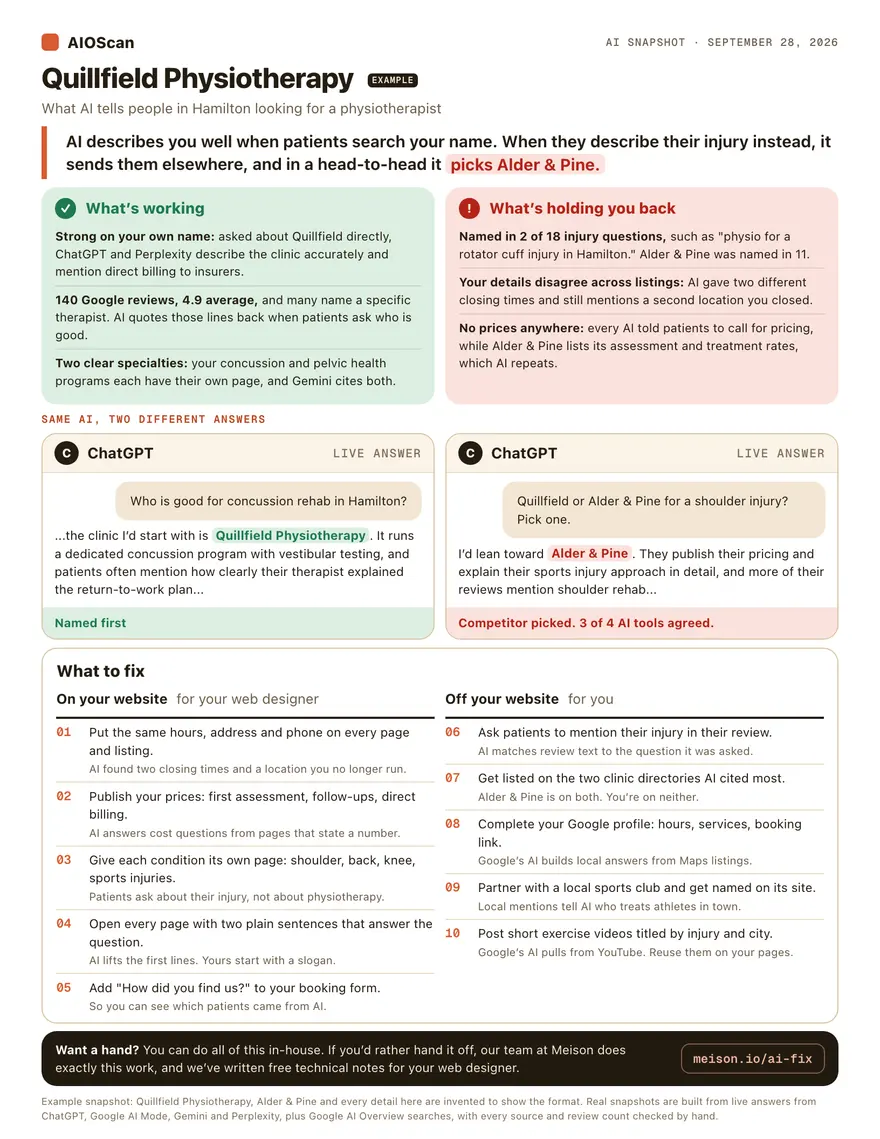
An example one-page AI Snapshot: a verdict, what's working, what's holding the business back, two live ChatGPT answers side by side, and ten fixes. An example snapshot. See it full size

Request your report

Two required fields. It is free, it takes a few days, and it comes back as one page: the verdict, what’s working, what’s holding you back, and ten fixes in order. See an example first.

No newsletter, no sales sequence. One email with the report, and one asking whether it was useful.

What does the report look like?

One page, with the verdict first and the fixes last.

Here is an example, built around an invented physiotherapy clinic so no real business is on display. Every snapshot follows this layout: what AI says about you, why, two live answers side by side, and ten fixes split between your web designer and you. It reads top to bottom in about two minutes. Download the example as a PDF.

AIOScan

AI Snapshot · September 28, 2026

Quillfield Physiotherapy Example

What AI tells people in Hamilton looking for a physiotherapist

AI describes you well when patients search your name. When they describe their injury instead, it sends them elsewhere, and in a head-to-head it picks Alder & Pine.

What’s working

  • Strong on your own name: asked about Quillfield directly, ChatGPT and Perplexity describe the clinic accurately and mention direct billing to insurers.
  • 140 Google reviews, 4.9 average, and many name a specific therapist. AI quotes those lines back when patients ask who is good.
  • Two clear specialties: your concussion and pelvic health programs each have their own page, and Gemini cites both.

What’s holding you back

  • Named in 2 of 18 injury questions, such as "physio for a rotator cuff injury in Hamilton." Alder & Pine was named in 11.
  • Your details disagree across listings: AI gave two different closing times and still mentions a second location you closed.
  • No prices anywhere: every AI told patients to call for pricing, while Alder & Pine lists its assessment and treatment rates, which AI repeats.

Same AI, two different answers

ChatGPT Live answer

Who is good for concussion rehab in Hamilton?

...the clinic I’d start with is Quillfield Physiotherapy. It runs a dedicated concussion program with vestibular testing, and patients often mention how clearly their therapist explained the return-to-work plan...

Named first

ChatGPT Live answer

Quillfield or Alder & Pine for a shoulder injury? Pick one.

I’d lean toward Alder & Pine. They publish their pricing and explain their sports injury approach in detail, and more of their reviews mention shoulder rehab...

Competitor picked. 3 of 4 AI tools agreed.

What to fix

On your website for your web designer

  1. 01 Put the same hours, address and phone on every page and listing.AI found two closing times and a location you no longer run.
  2. 02 Publish your prices: first assessment, follow-ups, direct billing.AI answers cost questions from pages that state a number.
  3. 03 Give each condition its own page: shoulder, back, knee, sports injuries.Patients ask about their injury, not about physiotherapy.
  4. 04 Open every page with two plain sentences that answer the question.AI lifts the first lines. Yours start with a slogan.
  5. 05 Add "How did you find us?" to your booking form.So you can see which patients came from AI.

Off your website for you

  1. 06 Ask patients to mention their injury in their review.AI matches review text to the question it was asked.
  2. 07 Get listed on the two clinic directories AI cited most.Alder & Pine is on both. You’re on neither.
  3. 08 Complete your Google profile: hours, services, booking link.Google’s AI builds local answers from Maps listings.
  4. 09 Partner with a local sports club and get named on its site.Local mentions tell AI who treats athletes in town.
  5. 10 Post short exercise videos titled by injury and city.Google’s AI pulls from YouTube. Reuse them on your pages.

Want a hand? You can do all of this in-house. If you’d rather hand it off, our team at Meison does exactly this work, and we’ve written free technical notes for your web designer.

meison.io/ai-fix

Example snapshot: Quillfield Physiotherapy, Alder & Pine and every detail here are invented to show the format. Real snapshots are built from live answers from ChatGPT, Google AI Mode, Gemini and Perplexity, plus Google AI Overview searches, with every source and review count checked by hand.

Why isn’t the AIO Score enough?

Because a perfect readiness score with zero presence is a hygiene score, not a visibility score. We have measured sites that score 97 out of 100 on the free scan and are never named when you ask an AI engine for their category in their city.

The evidence on why is consistent across everything we have read and tested: AI answers are built mostly from off-site sources, models behave like consensus machines, and when sources disagree they play safe and name someone else. The AIO Score covers the two gates on your own site. This report covers the five that live off it.

What are the seven gates?

Seven stages of the pipeline every AI engine uses to produce a recommendation, each scored as a gate you either clear or fall out at.

The pipeline is roughly the same everywhere: the engine rewrites the question into sub-queries, retrieves from a search index, judges titles and snippets, reads passages, arbitrates across sources, runs a reputation check, and synthesizes. The diagnosis is the first gate you fail, which is also the order to fix things in.

GateQuestionWhat we measureWhere
1 Reach Can AI fetch you? robots.txt, firewall, HTTPS, speed, JavaScript dependence AIO Score (free scan)
2 Readability Can AI lift a passage from you? answer up front, question headings, front-loaded sections, static FAQ, pricing stated AIO Score (free scan)
3 Rankings Can AI find you in the indexes it grounds on? top-20 presence in Google and Bing for the sub-queries AI generates for your category AI Presence report
4 Recognition Does the machine know who you are? entity home, one canonical description, profile set, facts that agree everywhere, Knowledge Graph presence AI Presence report
5 References Do the sources AI already cites mention you? presence on the exact pages and domains cited in live answers for your category and city AI Presence report
6 Reputation Does AI’s second check clear you? reviews on three or more platforms, outcome-specific review text, response rate, the “brand + reviews” results, negative threads AI Presence report
7 Recommendation Does AI name you? topic-level mention rate across engines, position in the list, accuracy, persistence over repeated runs AI Presence report (the headline)

What are the three numbers?

The AI Mention Rate, the AIO Score, and the AI Presence Score, because one number would have to lie.

The AI Mention Rate is the observed outcome: the share of live answers in which you are named, per engine and per topic, from repeated runs, for example “named in 3 of 24 answers, ChatGPT 0 of 6, Perplexity 2 of 6.” The AIO Score is the deterministic readiness score you already know, gates 1 and 2, unchanged. The AI Presence Score is new: gates 3 to 6, weighted 25, 20, 35, and 20 points, with off-site references carrying the most because they are the most repeated lever in the evidence.

Those weights are hypotheses. We record them next to observed Mention Rate for every site we run and refit them to whatever actually predicts being named. That calibration will be published here, the same way the AIO Score publishes its research.

How is the report produced?

By hand, from live queries across five engines, repeated, with a person reviewing every answer before anything is written up.

We pick four to six topics for your business (your category in your city, best-of, problem-led, cost, brand due diligence, and comparison), ask each several ways on each engine over repeated runs, and record whether you are named, where in the list, whether you are cited or only mentioned, what was said, and which sources were used. Those sources become your citation map: the exact pages AI uses to answer your category, checked one by one for whether you appear on them.

Rankings are checked for the sub-queries AI generates, in Google and Bing. Recognition is an entity audit across your profiles. Reputation is a cross-platform review and results-page audit. Then everything is written up with an owner tag on every item, developer or marketing.

What are the honest limitations?

The Mention Rate is a sampled estimate, the Presence weights are hypotheses until calibrated, and any gate we cannot measure is reported as unmeasured rather than guessed.

AI answers are non-deterministic and personalized, so the Mention Rate carries a stated run count, not a census. Published citation studies contradict each other, so the report trusts direct observation from your own live runs over any aggregate. The Presence weights stay labeled v1 until we have calibration data from thirty or more sites. Paid placements and press releases are measured but flagged as decaying tactics. Schema and llms.txt keep their near-zero treatment until evidence changes. A company too new to have a Knowledge Graph entity gets that gate marked unmeasurable, not failed.

How do you request one?

With the form at the top of this page. Two fields are required, the rest help us pick the right questions to ask the engines. Free for now; we run a limited number each week.

Back to the request form